Bone
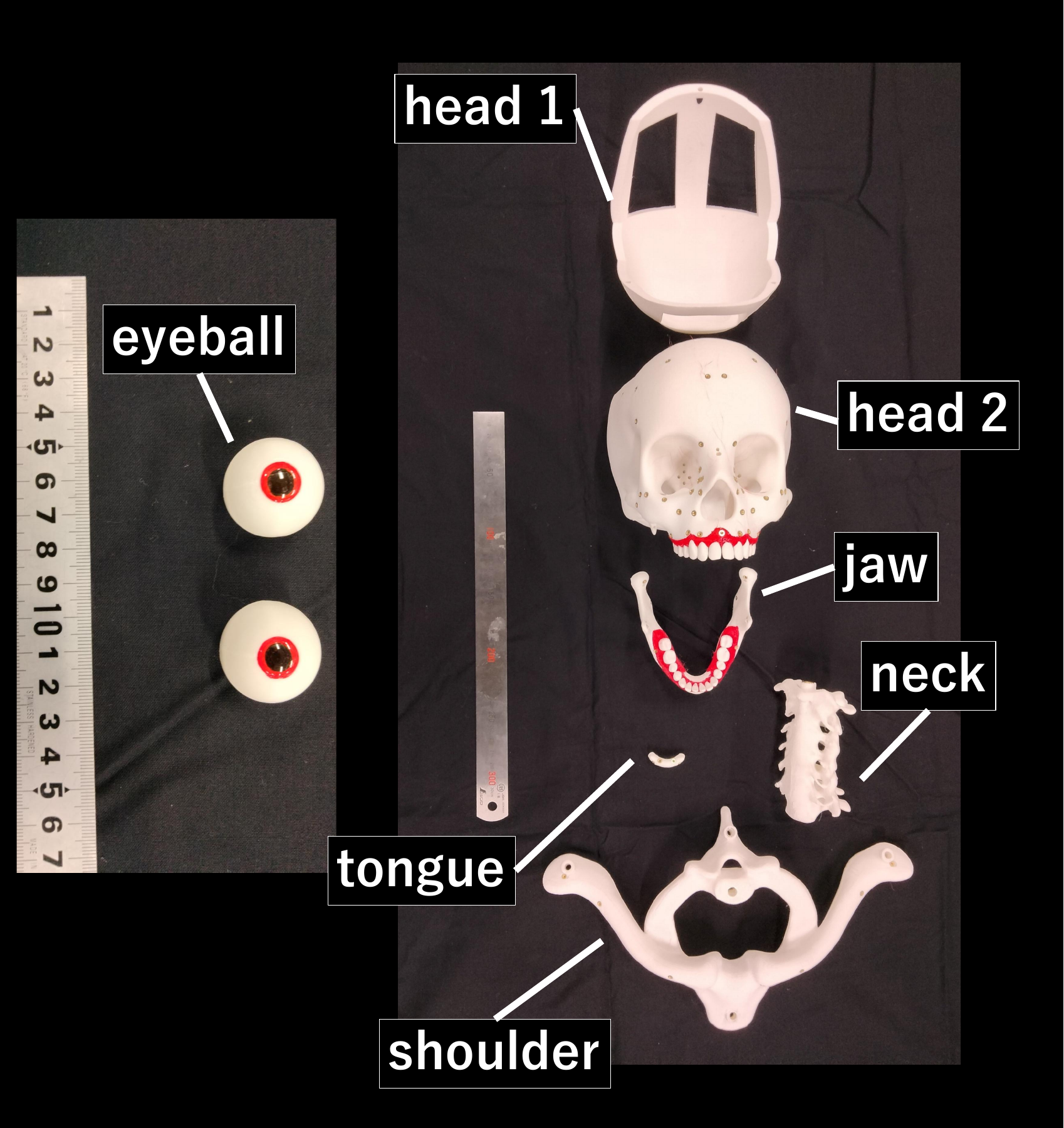
Five assemblies—head, jaw, tongue, neck, and shoulder—provide the structural foundation and attachment locations.
IEEE-RAS International Conference on Humanoid Robots (Humanoids 2026)
1 Department of Mechano-Informatics 2 AI Center
Graduate School of Information Science and Technology, The University of Tokyo
Facial robots require many coordinated, small-amplitude motions, but accommodating these motions in a compact face remains difficult. This paper presents an anatomically inspired facial-robot platform that reproduces the layered organization of the human facial musculoskeletal system. The platform comprises bone, muscle, and skin components whose geometry, shape, and attachment locations are derived from three-dimensional anatomical data. Wire-driven, compliant muscle components are routed through PTFE tubes, allowing actuation to be placed away from the face. We describe the selection and fabrication of 65 muscles (34 muscle types) required to reproduce the 47 target action units (AUs) in the Facial Action Coding System (FACS). We then evaluate the reproducibility of individual AUs in two stages: muscle actuation without skin and actuation after the silicone skin is attached. Forty of the 47 target AUs were reproduced with the muscle components, and 30 were reproduced after skin attachment. These results demonstrate the feasibility of reproducing a broad range of FACS facial expressions using an anatomically inspired musculoskeletal structure. The proposed platform provides a foundation for the systematic development and evaluation of future anatomically inspired facial robots.
See the assembled platform and examples of manually actuated facial movements.
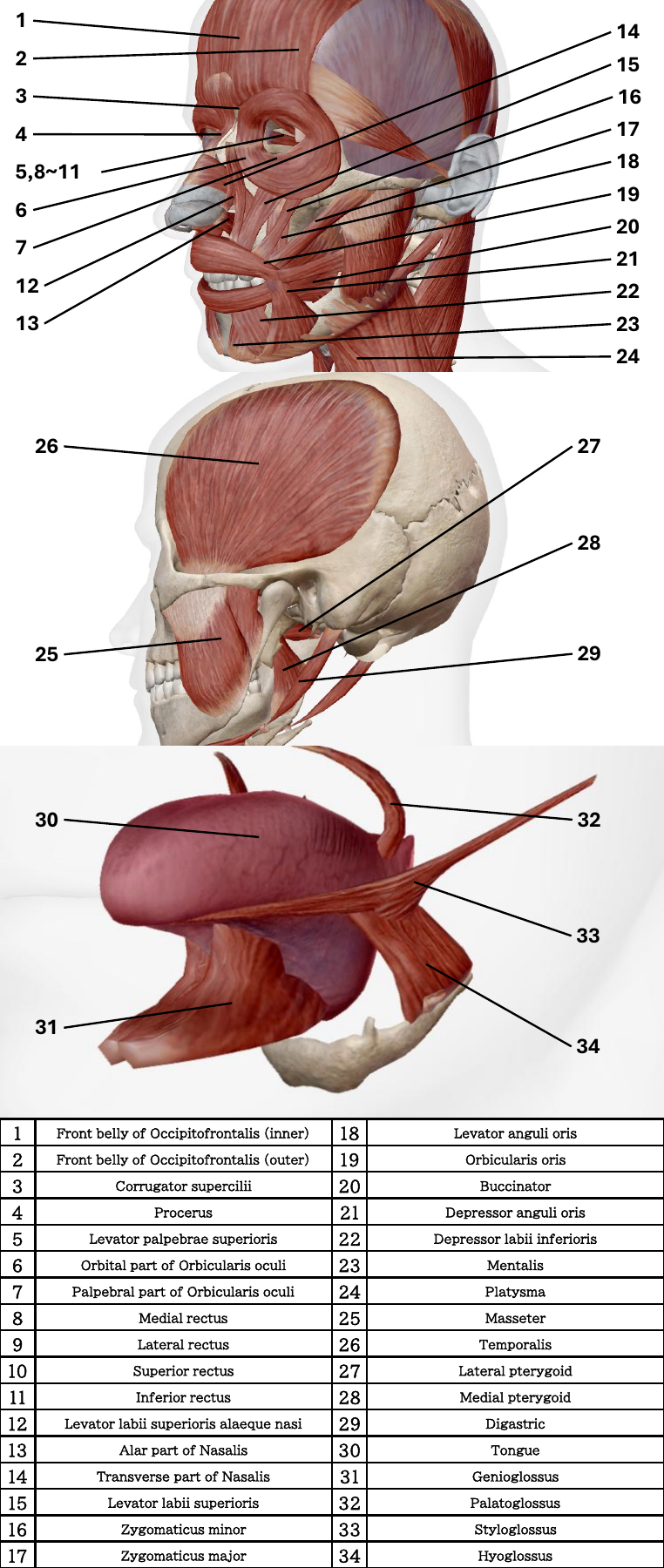
The Facial Action Coding System (FACS) links facial muscle activity to visible Action Units (AUs). To target 47 AUs, the platform implements 34 muscle types, totaling 65 individual muscles. Geometry and attachment locations are derived from three-dimensional anatomical data.
Five assemblies—head, jaw, tongue, neck, and shoulder—provide the structural foundation and attachment locations.
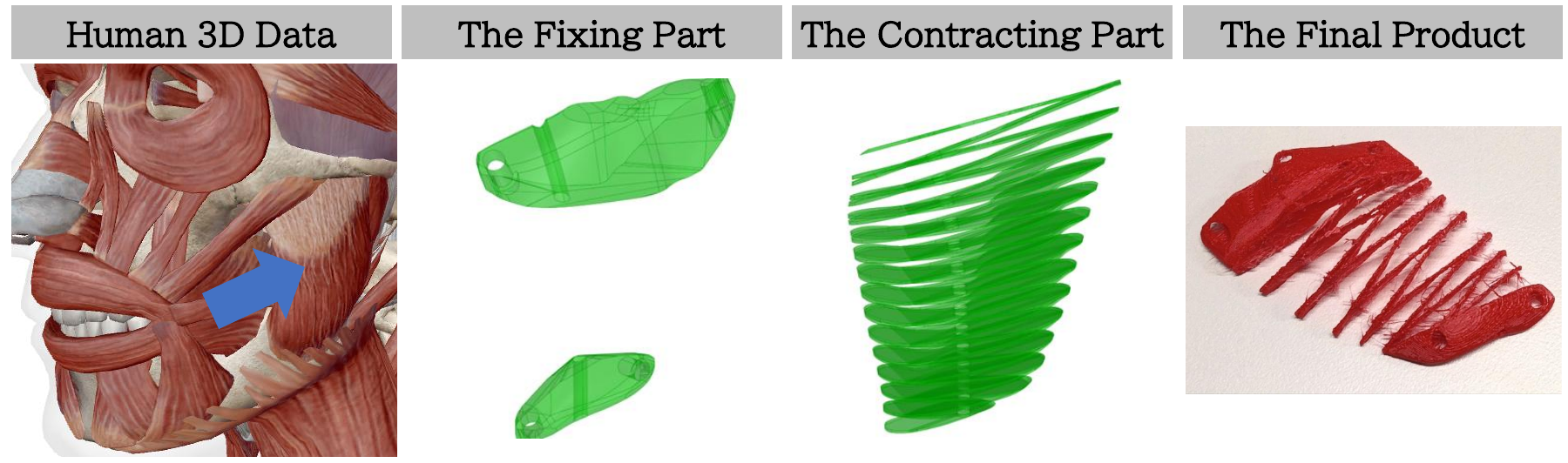
Wire-driven TPU components combine a fixing part with a compliant zigzag contracting part. PTFE tubes route the actuation wires away from the face.
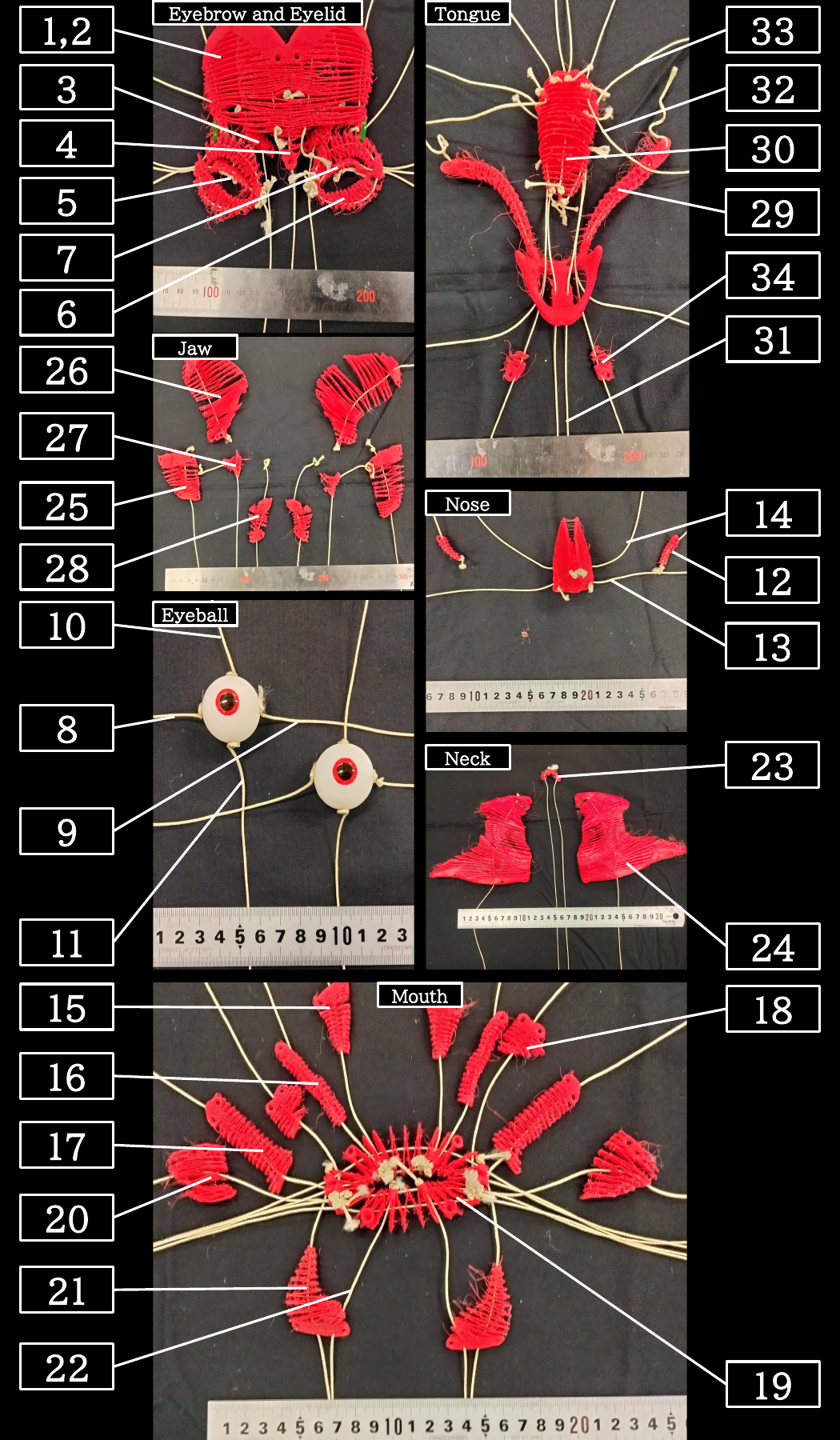
Fixing and contracting parts are generated separately and combined to preserve anatomical shape while enabling contraction.
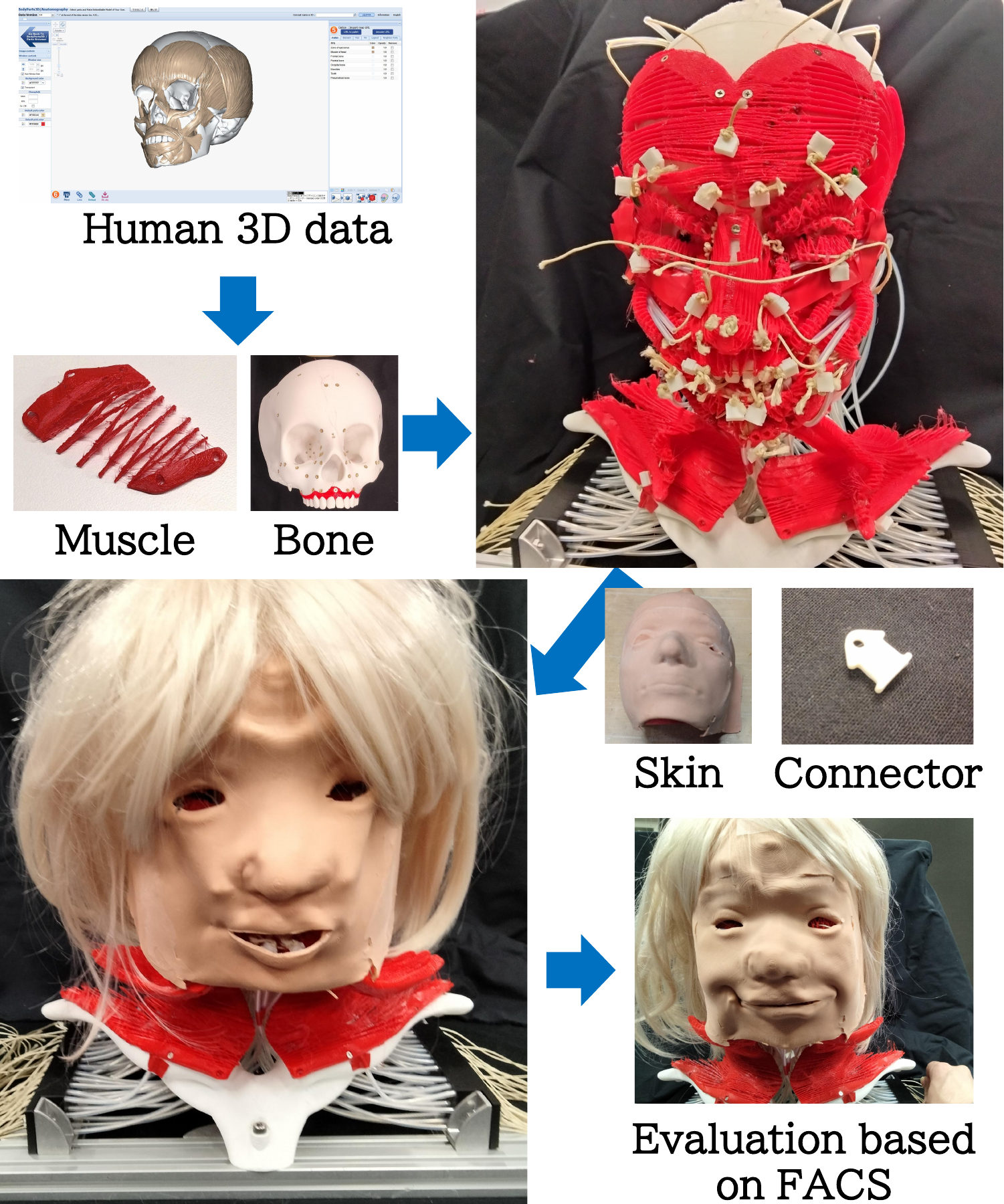
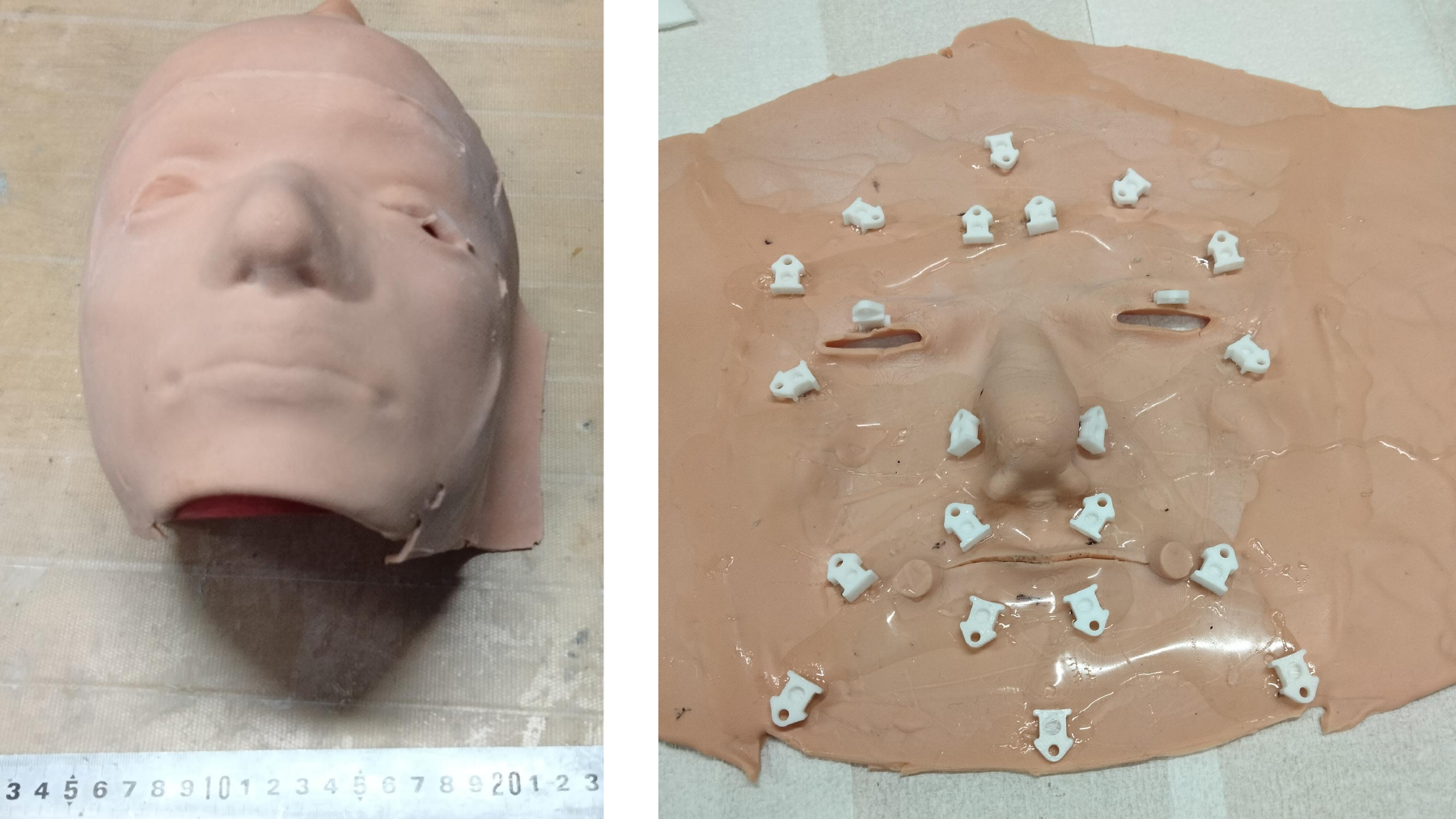
The skin is cast in sections and joined after demolding. Small connectors couple the silicone surface to the muscle wires, transferring the underlying contractions to visible facial movement.
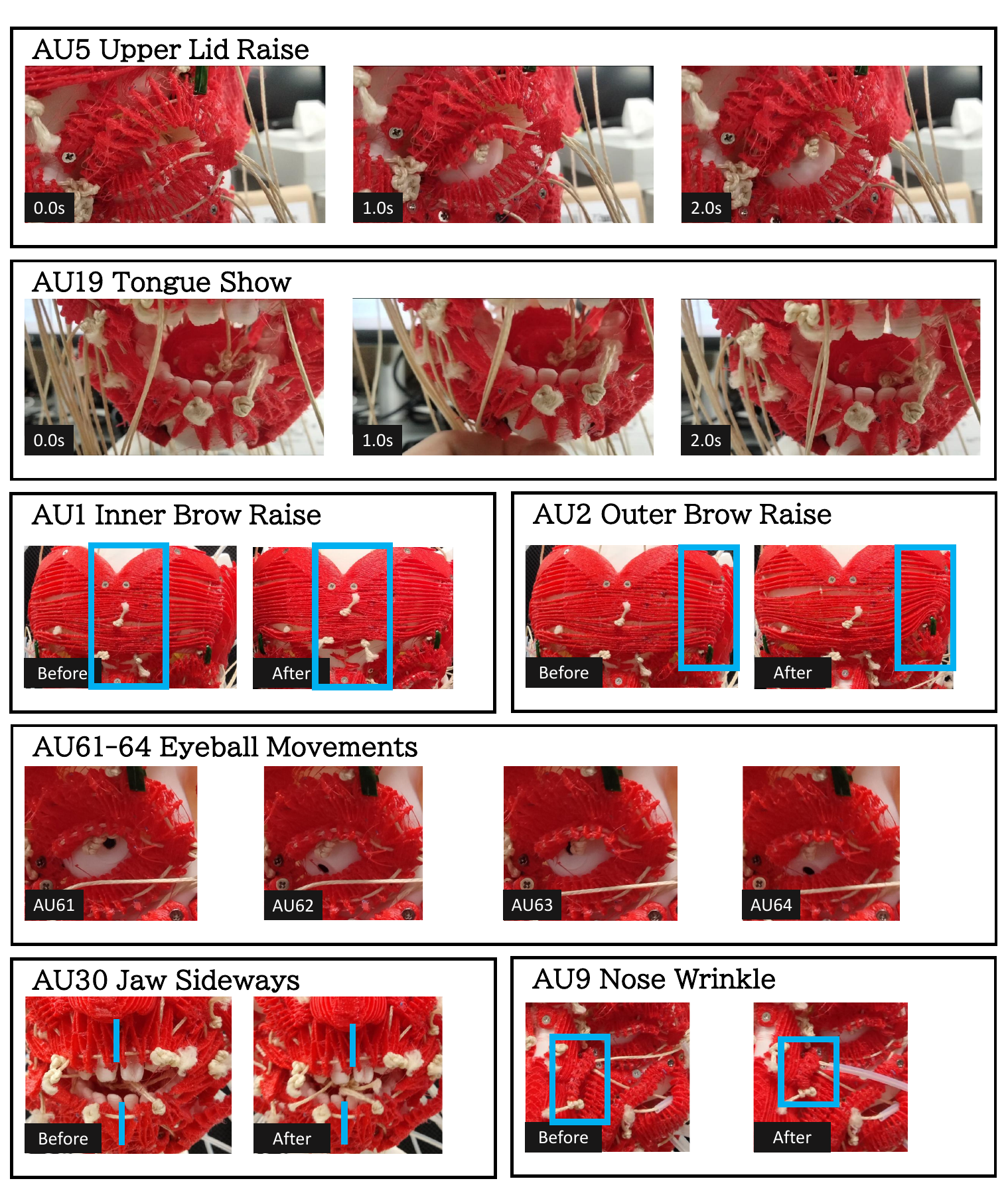
Each actuation wire was pulled manually. An AU was counted as reproduced when its intended motion was clearly observed. This qualitative evaluation separates the capability of the muscle structure from the effects of skin attachment.
The muscle components reproduced 40 of 47 target AUs, including eyebrow, jaw, eye, and tongue movements.
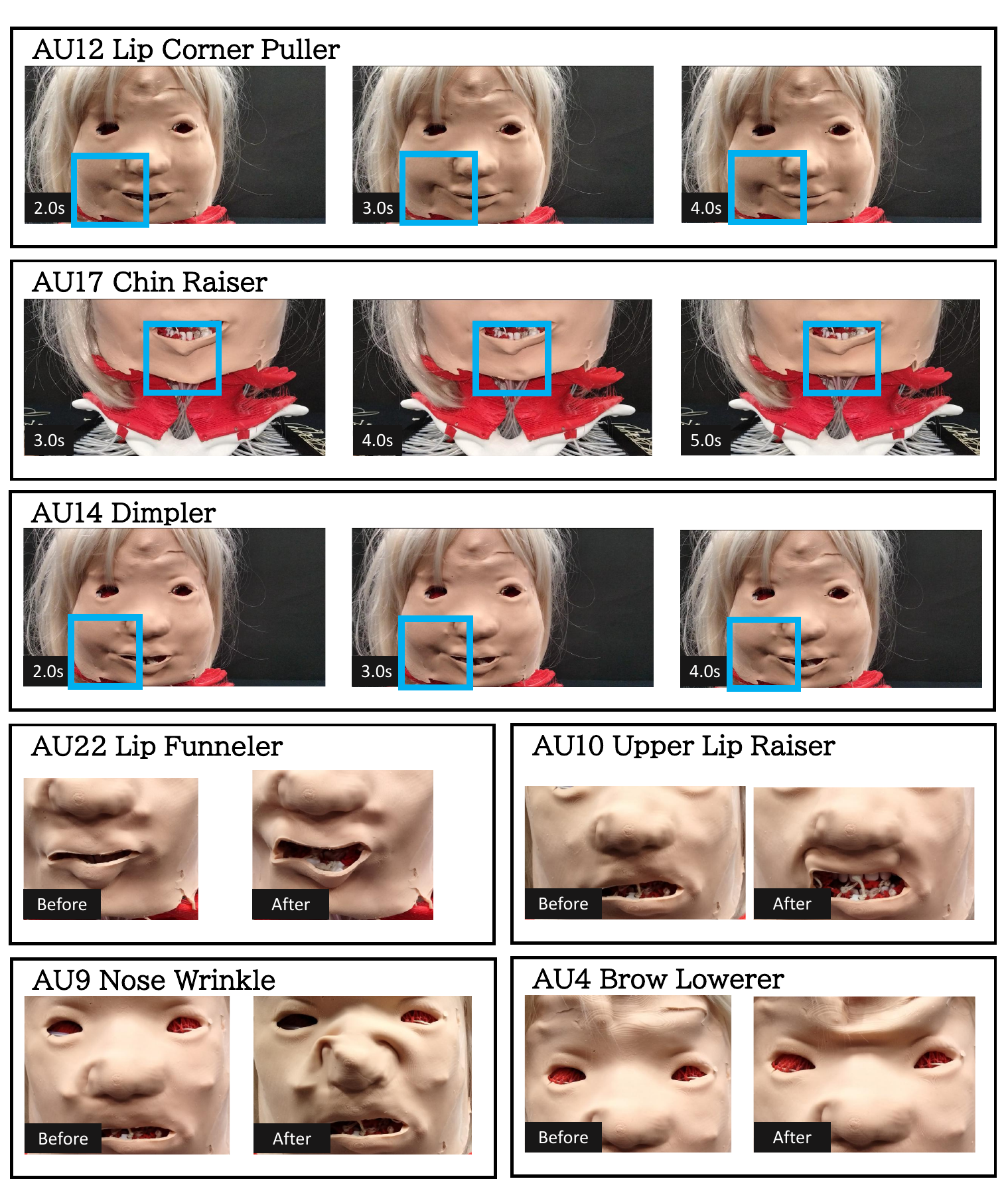
After attaching the skin, 30 of 47 target AUs remained visibly reproducible. The platform also produced chin protrusion, nasolabial folds, nasal wrinkles, and wrinkles around the mouth.
Limitations include the absence of pneumatic actuation for cheek puffing, anatomical attachment constraints, insufficient lip compliance, skin coupling around the eyes, tongue length, and interference between the jaw and wire tubes. Quantitative and perceptual evaluation, coordinated multi-AU expressions, and remote motor actuation remain future work.
@inproceedings{kaneko2026face,
  title = {{A Face Robot which Imitates Human Musculoskeletal Skin System
            and Its Evaluation on Basic Movement of Facial Expression}},
  author = {Shun Kaneko and Shunnosuke Yoshimura and Akihiro Miki
            and Kento Kawaharazuka and Kei Okada},
  booktitle = {Proceedings of the IEEE-RAS International Conference on Humanoid Robots},
  year = {2026},
  eprint = {2611.32413},
  archivePrefix = {arXiv},
  primaryClass = {cs.RO},
  url = {https://arxiv.org/abs/2611.32413}
}For questions about this work, contact Shun Kaneko at
kaneko@jsk.imi.i.u-tokyo.ac.jp.