Diffusion-Based Body Schema Learning
Enabling Abnormal-State Adaptation
in Musculoskeletal Robots
IEEE Robotics and Automation Letters (RA-L)
 arXiv
arXiv
Abstract
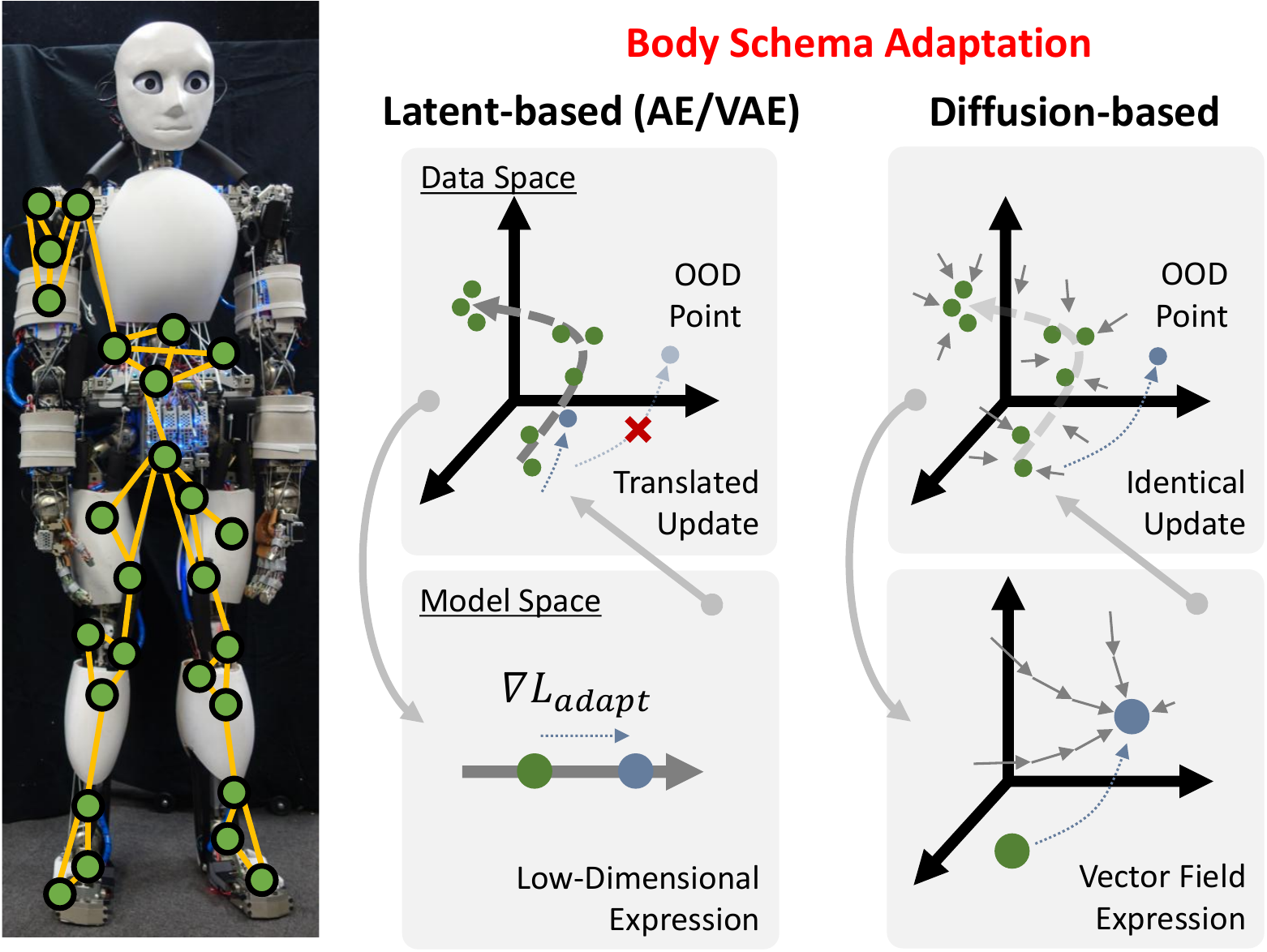
Musculoskeletal robots require an internal body schema that remains consistent under a wide range of physical state changes, including abnormalities such as muscle rupture and actuator jamming. Conventional approaches based on autoencoders or variational autoencoders learn average behaviors by projecting sensor and actuator signals into a low-dimensional latent space; however, exploration within the latent space alone has limited capability to handle out-of-distribution or abnormal states that are not included in the training data. To address this limitation, this study proposes a diffusion-based framework for body schema learning in musculoskeletal robots. Unlike generative models that operate through low-dimensional latent spaces, diffusion models can directly and iteratively estimate physically consistent sensor and actuator values in the high-dimensional space through a denoising process, even under partial observations and constraints, without requiring retraining. By formulating body schema adaptation as a gradient-guided denoising process, the proposed method enables adaptive estimation of appropriate muscle lengths and muscle tensions even under abnormal conditions such as muscle rupture and actuator jamming. The validity of the proposed framework is verified through simulation experiments using a musculoskeletal robot model.
Motivation
Musculoskeletal robots have redundancy, nonlinear elasticity, and anisotropy, making them promising platforms for adaptive behavior under physical abnormalities. To exploit this adaptability, the robot must estimate consistent joint angles, muscle lengths, and muscle tensions even when some muscles are ruptured or actuators are jammed. Latent-space models can adapt by optimizing latent variables, but their compressed representation can restrict reachable solutions for abnormal states outside the training distribution. The proposed diffusion-based formulation instead performs adaptation directly in the high-dimensional sensor-actuator space through denoising and gradient guidance.
Body Schema Learning
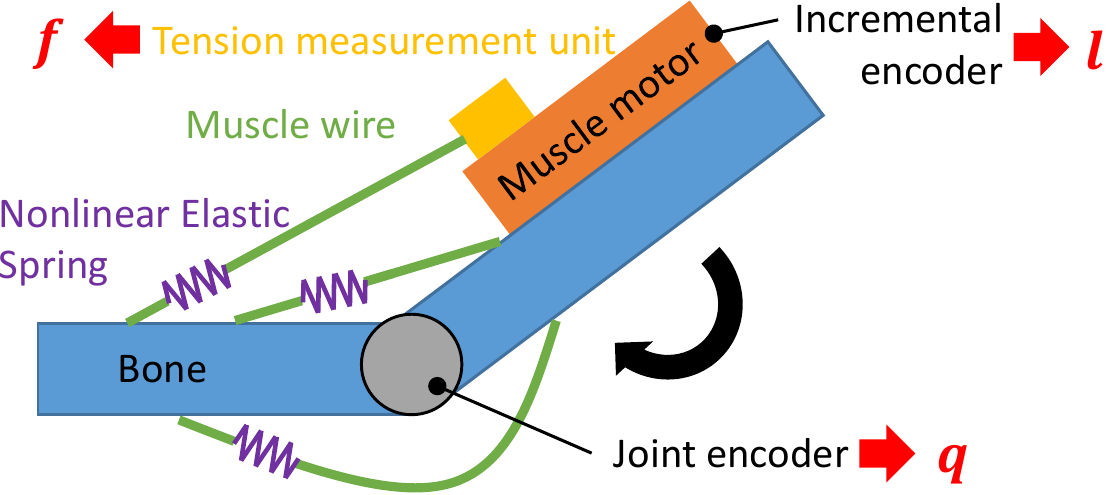
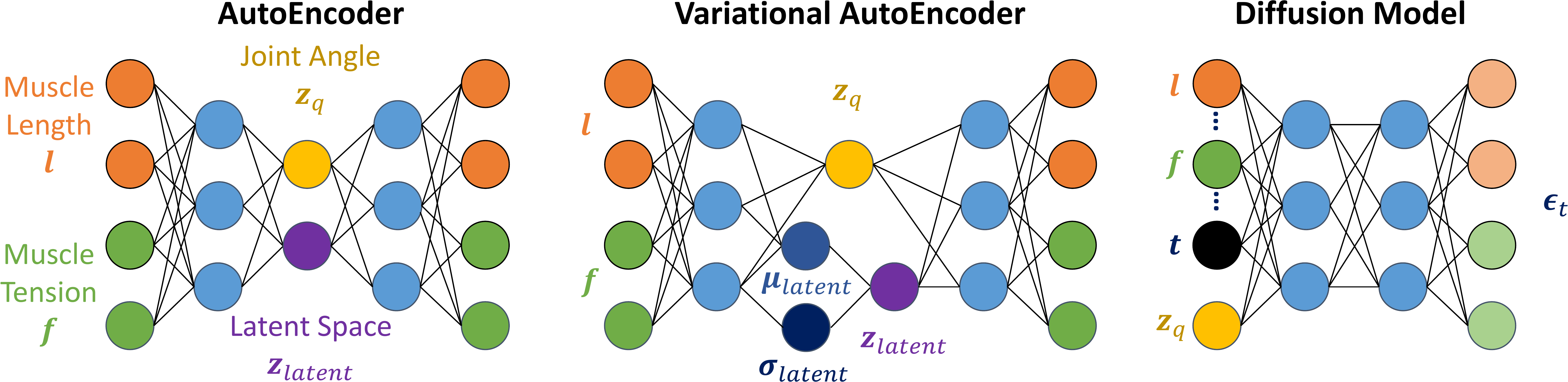
This work compares three body schema learning models: an autoencoder, a variational autoencoder, and a diffusion model. Each model learns the relationship among joint angles, motor-side muscle lengths, and muscle tensions. The autoencoder and variational autoencoder estimate outputs through a low-dimensional latent representation, while the diffusion model estimates sensor-actuator values by iteratively denoising high-dimensional variables conditioned on the joint angles.
Abnormal-State Adaptation
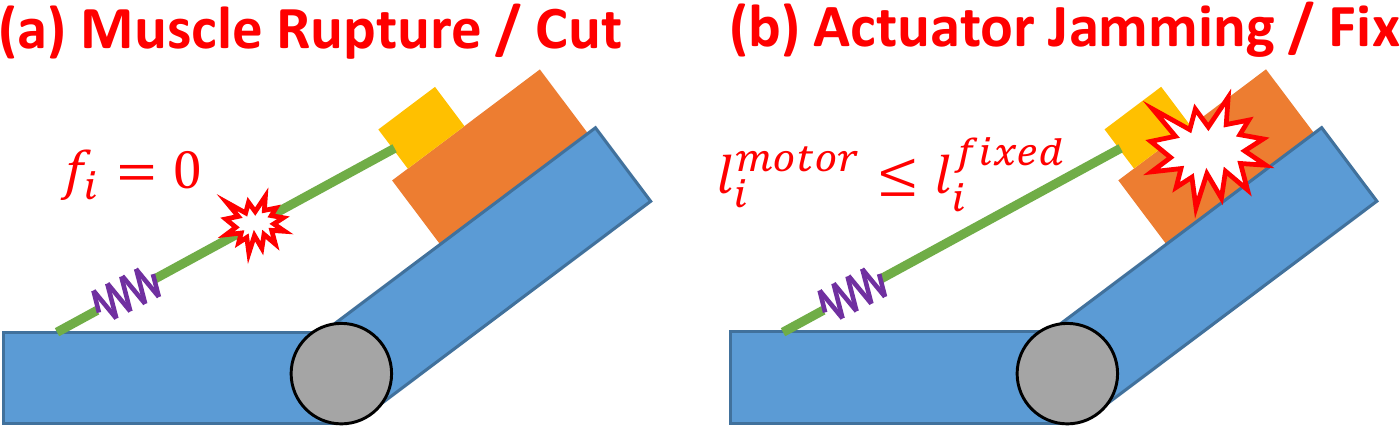
The study considers two abnormal states: muscle rupture, where the tension of a ruptured muscle becomes zero, and actuator jamming, where the muscle motor length cannot exceed a fixed jammed length. For autoencoder-based and variational-autoencoder-based schemas, adaptation is performed through latent-space optimization. For the diffusion model, these constraints are introduced as gradient guidance during the denoising process, allowing the generated muscle lengths and tensions to satisfy abnormal-state constraints without retraining.
Experimental Setup
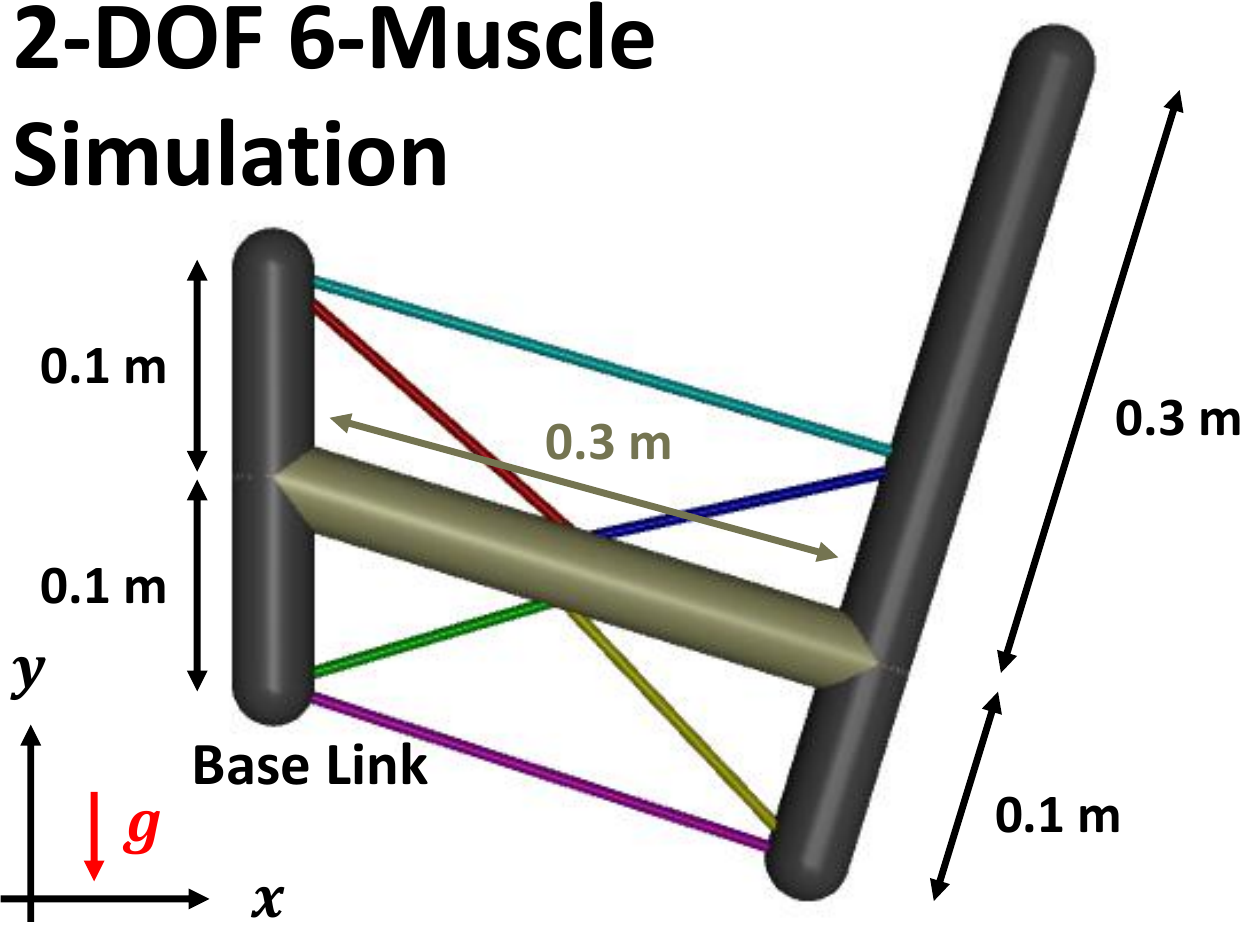
The framework is evaluated using a two-joint, six-muscle musculoskeletal robot model in simulation. Training data are generated by uniformly sampling joint angles, computing geometric muscle lengths and muscle Jacobians with MuJoCo, and solving for muscle tensions that satisfy static equilibrium and tension limits. The autoencoder, variational autoencoder, and diffusion model are trained with similar parameter counts, and adaptation is tested under CUT, FIX, and BOTH abnormal conditions.
Experimental Results
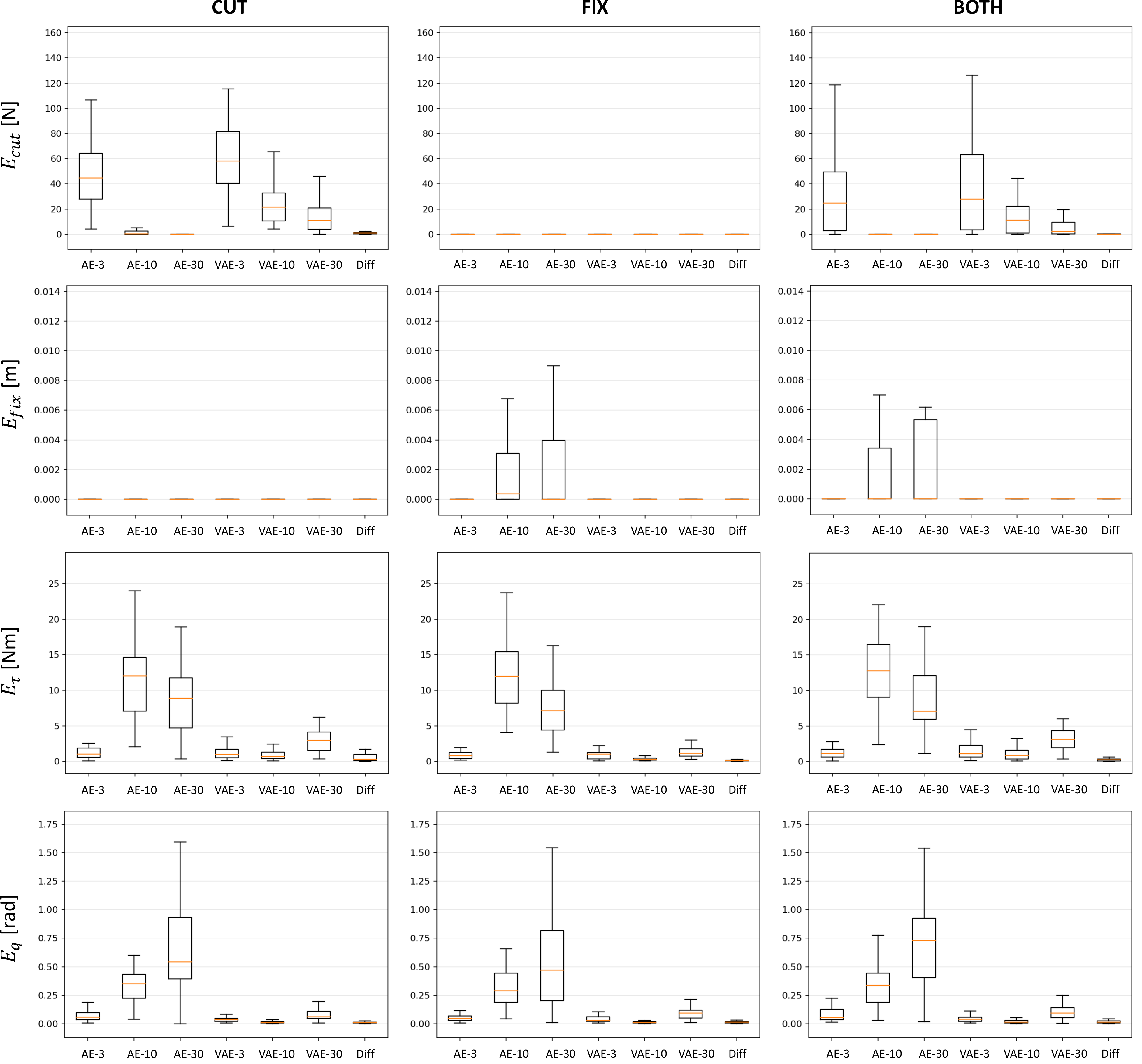
Adaptation performance is evaluated with four metrics: tension error for ruptured muscles, length error for jammed actuators, static equilibrium error, and joint angle error. Across CUT, FIX, and BOTH conditions, the diffusion model consistently achieves strong adaptation performance while satisfying abnormal-state constraints and maintaining static equilibrium and joint angle accuracy. The results indicate that directly operating in the high-dimensional sensor-actuator space is effective for redundant robots, especially under abnormal conditions that are not included in the training data.
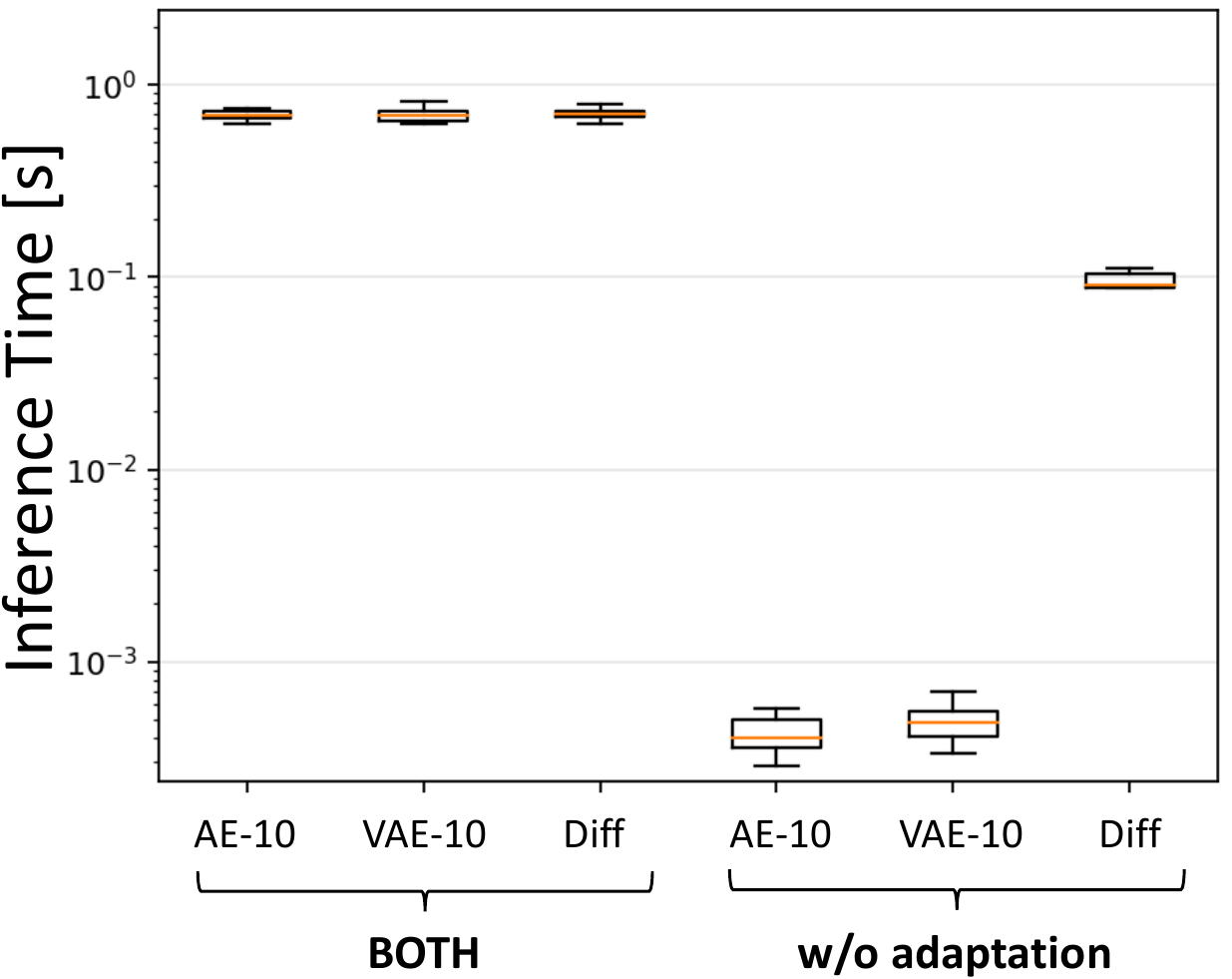
Inference without adaptation is faster for autoencoder and variational autoencoder models, while the diffusion model requires iterative denoising. With adaptation enabled, all compared methods require approximately 0.7 s in the reported implementation, leaving faster diffusion-based adaptation as an important direction for dynamic motions.
BibTeX
@article{kawaharazuka2026diffusion,
  title={{Diffusion-Based Body Schema Learning Enabling Abnormal-State Adaptation in Musculoskeletal Robots}},
  author={Kento Kawaharazuka and Shuhei Ikemoto},
  journal={IEEE Robotics and Automation Letters},
  year={2026},
}
Contact
If you have any questions, please feel free to contact Kento Kawaharazuka (kawaharazuka@jsk.imi.i.u-tokyo.ac.jp).